
 Français
 Русский
 Deutsch






The protection of endangered bees
Bees existed long before humanity appeared. They represent the most important pollinators of plant biodiversity. If they were to disappear, humans would only have approximately four years of survival left, because without these pollinators, crops would become sterile.
WHO ARE BEES?
Bees are flying insects that are exclusively vegetarian. They are often confused with wasps, yet bees are far less aggressive than their cousins. Indeed, the serrated shape of their stinger prevents them from surviving after stinging. While wasps may attack during meals for meat or sugary foods, bees simply gather nectar from flowers to produce honey for their colony. Bees can be recognized by their stockier shape and darker color, ranging from light brown to black depending on the species.
POLLINATION
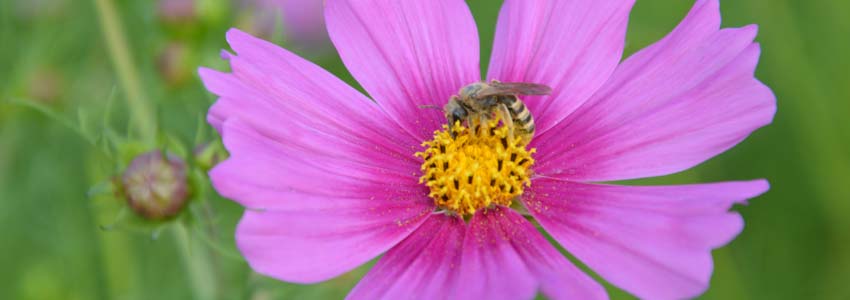
While collecting nectar from flowers, bees unintentionally come into contact with the plant’s reproductive organs. By carrying pollen from the stamen to the pistil, bees ensure the growth of future generations of plants. Without them, our ecosystem would lose one of the fastest and most efficient ways of spreading life.
In Southwest China, due to the shortage of bees caused by various forms of pollution, farmers in Sichuan Province are forced to pollinate apple trees by hand. This difficult task requires climbing high branches and pollinating flower after flower manually.
Garlic, almonds, asparagus, eggplants, beets, cherries, chestnuts, cabbages, pumpkins, cucumbers, strawberries, raspberries, currants, lettuce, watermelon, mustard, blackberries, onions, sweet potatoes, peaches, parsley, pears, apples, plums, radishes, grapes… these are only some of the foods pollinated by bees. Without them, we would need to pollinate plants manually with tiny pipettes — or simply go without these foods.
ENDOCRINE SYSTEM
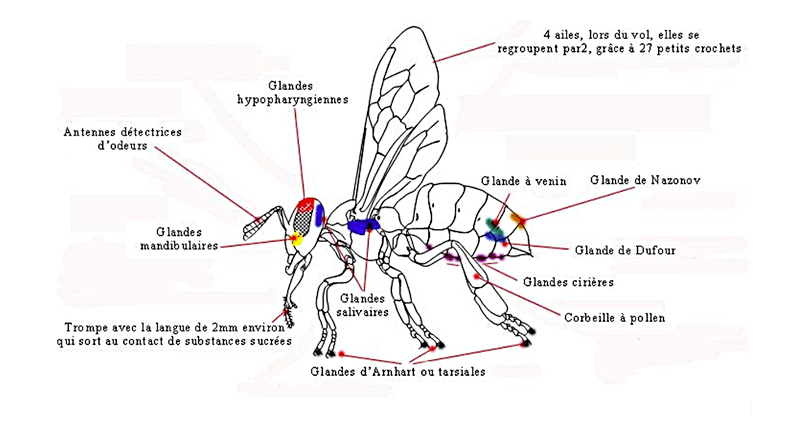
While the human endocrine system contains nine endocrine glands, bees possess 28. The complexity of this system is so extraordinary that it would require an entire article to explain it fully. However, here are a few examples:
The hypopharyngeal glands allow bees to secrete lipids, proteins, and vitamins used to feed larvae inside the hive. Nutrition plays a major role in the insect’s development: if a bee receives abundant pollen during its first six days of life, its wax glands become more developed and it becomes a forager bee.
Bees possess no fewer than eight wax glands, enabling them to produce wax used to build honeycomb cells.
The Dufour gland secretes a repellent substance, allowing forager bees to mark flowers that have already been visited in order to optimize nectar collection for the colony.
The Nasonov gland allows bees to release pheromones that call surrounding bees. This behavior is known as “calling the swarm.” The bee adopts a specific posture while fanning its wings and raising its abdomen to expose the gland.
These few examples already reveal the incredible complexity, precision, and delicacy of such a small yet immensely valuable creature for humans, flowers, plants, and the planet.
WHAT THREATENS AND DESTROYS THIS SPECIES
Electromagnetic Pollution
In 2011, Swiss biologist Daniel Favre published a study in Lausanne demonstrating that waves emitted by mobile phones greatly disturb worker bees inside a hive. When a phone was placed near the hive while receiving or sending calls, the sound level inside the hive increased tenfold compared to normal conditions, reflecting extreme agitation among the bees.
Bees located near cell towers may also lose their sense of orientation, becoming unable to return to their hive.
The expansion of 5G technology in our environment is expected to further increase these disruptive effects.
Pesticides
British scientists conducted experiments on the effects of pesticides on larval brain development, focusing on neonicotinoids found in many insecticides. More than one hundred bees were fed nectar containing neonicotinoids, and their brains were analyzed using 3D X-ray microtomography.
The results revealed brain atrophy in contaminated larvae compared to healthy ones.
Varroa Mite
The Varroa mite is a parasite originating from Southeast Asia. European bees (Apis mellifera) do not naturally survive Varroa infestations, while Asian bees (Apis cerana) have developed resistance over time.
Today, bees are weakened by pesticides and electromagnetic smog, making them more vulnerable to parasites such as Varroa. Their immune defenses can no longer respond effectively despite their highly developed endocrine system.
WHAT IF BEES COULD ALSO BENEFIT FROM BETTER HYGIENE?
SOLUTIONS PROVIDED BY CYTAMPHOLOGY
Cytamphology may help bees by strengthening their endocrine system. Bees appear highly receptive to this science based on the use of natural energy emitted by plant active principles.
This concept led to the creation of API 2011, a product combining biophysical information and energetic stimulants that help bees defend their hive, prevent predator intrusion, and even expel them.
Stronger bees can forage farther distances, collect more pollen, strengthen the queen’s immune defenses, become less sensitive to environmental disturbances, and help each hive produce more honey.
API 2011 is the result of several years of scientific research and experimentation involving transfers of vital energy from multiple plants into a substrate added to bee syrup feed.
Recommended dosage:
- 3 drops of API 2011 per liter of syrup
- 6 drops per week applied on a wooden landing board
- 1 bottle of 15ml for 3 hives per season
This is not considered a medication in the curative sense, but rather a transfer of energy-information intended to help bees regain their original vitality and resistance capacities.
API 2011 contains a CYTAMPHOLOGICAL formula composed exclusively of natural active principles in a vegetable oil base.
OBSERVED RESULTS
- More populated hives
- More efficient and productive bees
- Better defenses against Varroa mites and hornets
- Greater resistance to electromagnetic disturbances and pesticides
- Improved winter survival of the hive
API 2011 has been used for over 20 years by beekeepers committed to preserving the health of their hives and aware of the essential role bees play for humanity.
LET US NEVER FORGET THAT THE TOTAL DISAPPEARANCE OF BEES WOULD HAVE MORE CONSEQUENCES THAN A NUCLEAR WAR.